If you are looking for inspiring rock bottom quotes to help you rebuild your life, hitting rock bottom is rarely as dramatic as movies make it out to be. More often, it’s a quiet, heavy realization that things cannot go on as they are. Whether brought on by heartbreak, financial loss, burnout, or grief, reaching your lowest point feels like running out of room to fall.
In many personal stories and philosophical traditions, rock bottom is described not as a permanent trap, but as a floor. In this place, you finally stop falling, look around, and evaluate what remains.
The right words will not solve life’s challenges or undo what happened. But when everything around you feels chaotic, reading how others survived their dark hours can offer a steady anchor. Below is a complete 75-quote collection alongside practical frameworks, historical perspective, and reflection exercises designed to help you navigate your lowest point and systematically rebuild your life step by step.
Quick Answer
Rock bottom quotes are powerful reminders that difficult moments can become turning points for growth, healing, and rebuilding. They help people find strength, hope, and perspective when life feels overwhelming.
Who Can Use These Rock Bottom Quotes?
These quotes are for anyone going through difficult life changes, heartbreak, failure, loss, or moments when they need motivation to rebuild and move forward.
Who Are These Rock Bottom Quotes For?
These rock bottom quotes are for people experiencing life challenges, failure, heartbreak, loss, burnout, or personal struggles. They are useful for self-reflection, motivation, journaling, social media captions, and encouraging someone who needs hope.
Navigating Rock Bottom: A Grounded Approach
Reaching your limit forces an unexpected pause. When the strategies you previously used to manage stress, preserve relationships, or maintain financial stability no longer function, your mind experiences acute exhaustion.
A Practical 5-Step Framework for Rebuilding
Stabilize:
Pause non-essential decisions and focus entirely on basic daily functioning and emotional rest.
Accept the Current Reality:
Acknowledge your starting point without wasting energy on denial or wishful thinking.
Identify What You Can Control:
Separate unchangeable external events from small choices you can make today.
Rebuild Daily Routines:
Re-establish simple, manageable daily habits to restore a sense of order.
Create a Longer-Term Plan:
Gradually set modest, realistic goals as your mental clarity returns.
Loss of Identity and Direction
When major parts of life collapse—such as a career, relationship, or long-term goal—it can become difficult to know who you are outside those roles. This period can also create an opportunity to reconsider your values, priorities, and sense of direction.
Accepting Current Reality
Reaching a low point can sometimes make acceptance of the current reality unavoidable. From there, attention can gradually shift away from grieving the breakdown toward what can still be changed.
Stress and Decision Fatigue
Prolonged stress can make everyday decisions feel harder and can leave you mentally exhausted. During a crisis, reducing your focus to basic needs and small decisions can make the situation feel far more manageable.
1. Famous Rock Bottom Quotes (With Analysis)
Throughout history, writers, leaders, and thinkers have stood in deep adversity and tried to put that weight into words. These well-known lines explore adversity, resilience, hope, and the possibility of rebuilding.
1. “And so rock bottom became the solid foundation on which I rebuilt my life.” — J.K. Rowling
Analysis: Spoken during a commencement address reflecting on her life before publishing Harry Potter, Rowling highlights the paradox of major failure. When non-essential options are gone, you lose the paralyzing fear of failure itself. What remains is a clean baseline free from external expectations.
2. “In the depth of winter, I finally learned that within me there lay an invincible summer.” — Albert Camus
Analysis: Camus refers to inner reserves of resilience that remain hidden during comfortable times. Hardship does not create strength out of nowhere; rather, it exposes an enduring capacity to tolerate pain that was previously obscured.
3. “Out of suffering have emerged the strongest souls; the most massive characters are seared with scars.” — Kahlil Gibran
Analysis: Gibran presents suffering as an experience that can leave lasting marks on a person’s character. Emotional scars serve as evidence of tissue that tore, healed, and hardened—signaling survival rather than permanent damage.
4. “My barn having burned down to the ground, I can now see the moon.” — Mizuta Masahide
Analysis: This 17th-century Japanese haiku poet captures perspective shifts following catastrophic loss. The barn represented structure, safety, and assets. Its destruction was devastating, yet its absence unexpectedly revealed an unobstructed view of the night sky—a reminder that loss can reveal clarity previously hidden by structure.
5. “We must accept finite disappointment, but never lose infinite hope.” — Martin Luther King Jr.
Analysis: Dr. King distinguishes between temporary setbacks and overarching purpose. Disappointments are “finite”—they have measurable boundaries and specific causes. Hope, conversely, is an enduring orientation toward the future that prevents temporary losses from dictating a lifelong trajectory.
6. “If you’re going through hell, keep going.” — Winston Churchill
Analysis: Churchill’s line is often interpreted as a reminder to keep moving through difficult circumstances rather than allowing a temporary crisis to become a permanent stopping point. Continuing forward, even slowly, helps ensure you eventually exit the environment causing distress.
7. “What lies behind us and what lies before us are tiny matters compared to what lies within us.” — Ralph Waldo Emerson
Analysis: Emerson emphasizes internal agency over external circumstances. Past mistakes and future uncertainties fade when evaluated against your immediate internal capacity to adapt, decide, and act.
8. “Although the world is full of suffering, it is also full of the overcoming of it.” — Helen Keller
Analysis: Keller acknowledges suffering as a fundamental condition of human existence, while pointing out that human history is equally defined by adaptation, endurance, and triumph over limitations.
9. “The gem cannot be polished without friction, nor man perfected without trials.” — Seneca
Analysis: Associated with Stoic philosophy, this statement asserts that hardship plays a role in personal development. Just as abrasive force removes the raw edges of stone to reveal a gem’s shine, life’s friction can refine discipline, character, and focus.
10. “Fall seven times, stand “p eight.” — Japanese Proverb
Analysis: This proverb reframes resilience as an ongoing choice rather than a single event. Rebuilding is not about avoiding future falls; it is about establishing a persistent habit of always attempting one more recovery than the total number of setbacks.
Sometimes the hard isn’t hitting rock. It’s tom. It’s believing you can actually climb out of it. Maybe everything looked fine from the outside while you were struggling with that. If that’s where you are right now, don’t worry about seeing the whole staircase—taking one small step is enough for today.
Historical Case Studies: Perspective on Rebuilding

Historical examples can offer useful perspective: people have experienced major setbacks and later rebuilt parts of their personal or professional lives in very different ways.
J.K. Rowling
- The Context: In the early 1990s, Rowling was a recently divorced single mother living on government assistance while working toward completing the Harry Potter manuscript.
- The Pivot: She viewed her difficult circumstances as a form of simplification. Having hit what felt like a low point, she focused her limited time and energy on writing.
- Key Takeaway: Major setbacks can simplify priorities by removing minor distractions and the fear of failure.
Abraham Lincoln
- The Context: Lincoln experienced several major personal and professional setbacks in the 1830s, including business failure, debt, political defeat, and the death of his close companion Ann Rutledge.
- The Pivot: His later career illustrates how long-term rebuilding can happen through continued learning, steady work, and public service over several decades.
- Key Takeaway: Recovery rarely follows a single, sudden breakthrough. Incremental efforts sustained over years can build an enduring legacy.
Steve Jobs
- The Context: In 1985, Jobs was removed from his leadership role at Apple following an internal power struggle with the board of directors.
- The Pivot: Jobs later reflected that leaving Apple allowed him to approach work with fresh curiosity. He used this period to found NeXT and acquire Pixar, leading to creative successes that eventually facilitated his return to Apple.
- Key Takeaway: Professional disruption can serve as an incubator, stripping away legacy obligations and allowing fresh innovation.
2. Original Quotes About Hitting Rock Bottom and Rising Again
Reaching the floor forces a shift. It isn’t always about dramatic turnarounds; sometimes it’s simply about choosing not to stay down forever.
- “When you hit rock bottom, the only direction left to look is up, and the only path left is forward.”
- “A setback is often just a rough start to a shaven’tu haven’t finished wri” i”g yet.”
- “The floor at the bottom of the pit doesn’t yield, but you can push off it.”
- “You don’t always notice your own strength when life is easy; you discover it when things break.”
- “Rock bottom strips away the extra noise and shows you what actually matters to you.”
- “Risiisn’tain isn’t about ignoring it’sire; it’s about acknowledging what sur” i”ed it.”
- “Every closed path forces you to look for a doorway you would have otherwise walked past.”
- “When options get stripped away, your priorities become painfully, clearly visible.”
- “You aren’t defined by how hard you landed, but by what you decide to do once you get back up.”
- “Falling is something that happens to you; choosing to try again is something”y”u own.”
- “Even the heaviest storms eventually run out of rain.”
- “When you fyou’veke you’ve been buried under everything, remember that seeds need dark soil”t” grow.”
- “Where you are right now is a chapter in your life, not the entire book.”
- “Hard times have a way of revealing the didn’tou didn’t know you ha” “n you.”
- “Real progress starts quietly, the moment you decide that staying isn’t where your st”r” ends.”
- “The lowest point of your life often marks the unannounced beginning of something comple”e”y new.”
- “Character is built in the quiet valleys of life, rarely on the ea”y” peaks.”
- “The night feels endless right before the morning comes, but darkness always gives way ev”n”ually.”
- “Deep sorrow empties you, but it also creates space for peace to retyou’reen you'”e” ready.”
- “Sometimes things have to fall apart entirely before you can see what was holding you back.”
- “When the road ahead feels impossibly steep, stop looking at the top and just watch y”ur feet.”
- “You rarely realize how much you can endure until enduring becomes your daily reality.”
Not every low point needs an immediate comeback. Sometimes you just need permission to rest, cry, be disappointed, and simply get through the day. Healing can begin long before you actually feel strong again.
Research in psychology shows that resilience is not simply an inborn trait; it can develop through coping skills, supportive relationships, and the ability to adapt during difficult experiences. Understanding resilience can help people view setbacks as challenges that can be managed rather than permanent failures.
A Step-by-Step Reconstruction Roadmap: The First 30 Days
Rebuilding after a major loss requires a quiet, practical approach to prevent decision fatigue.
Days 1–7: Stabilize & Triage
- Secure basic needs such as sleep, adequate nutrition, and hydration.
- Pause non-essential major life decisions where possible.
- Identify one trusted person, family member, or professional for practical support.
Days 8–14: Reality Audit
- Separate clear, objective facts from emotional assumptions or catastrophic thoughts.
- Take inventory of your remaining assets, skills, personal relationships, and resources.
- Reduce unnecessary financial, social, and emotional drains.
Days 15–21: Establish Micro-Routines
- Set a consistent, achievable wake-up and bedtime schedule.
- Complete one small daily physical task, such as a 15-minute daily walk.
- Spend 10 minutes writing down simple reflections each evening.
Days 22–30: Define the Next Step
- Identify a single, manageable goal for the next 60 to 90 days.
- Break that goal down into concrete weekly action items.
- Take one small outward step, such as sending an inquiry, updating a resume, or attending an appointment.
3. Original Quotes for Mental & Emotional Healing at Your Lowest Point
Healing after a major loss or failure requires gentleness rather than harsh discipline. These original lines focus on quiet self-compassion and giving yourself room to “ecover.
- “Resting at thisn’ttom isn’t quitting; sometimes your spirit just needs a moment to catch it” “reath.”
- “Sometimes healing feels heavy because your heart is still learning how to carry what happened.”
- “It is okay to pause and gather yourself. Even the moon goes through phases of darkness before returning full.”
- “It isn’t a straight line, and having a do-over doesn’t erase the progress you made yesterday.”
- “Be gentle with yourself. You are letting go of a life you expected so you can live the one you have.”
- “The hard things you sit with today often turn into the quiet understanding you offer someone else tomorrow.”
- “You don’t have to fix your whole life by tonight; just focus on getting through the next few hours calmly.”
- “Broken plans can still leave behind valuable lessons worth keeping.”
- “Try not to blame yourself for not knowing earlier what you could only learn by going through this.”
- “Getting through your hardest days so far reminds you that you can take this one day at a time, too.”
- “Crying can be one way people release and process difficult emotions; it doesn’t mean you’ve failed.”
- “Give yourself grace. You’re trying to rebuild your daily life while still feeling the weight of the damage.”
- “Peace doesn’t mean the bad stuff goes away; it means finding a quiet spot inside yourself while it passes.”
- “You are allowed to grieve what didn’t work out while quietly figuring out what comes next.”
- “A difficult week, month, or year can change your life without defining who you become.”
- “Healing does not erase the past; it teaches you how to carry it differently.”
- “Even after the longest night, you can begin again with the light you have.”
On difficult days, you may not have the mental energy to read long paragraphs or analyze complex advice. Sometimes one honest, simple sentence is enough to give you something steady to hold onto.
4. Short Rock Bottom Quotes for Captions & Daily Reminders
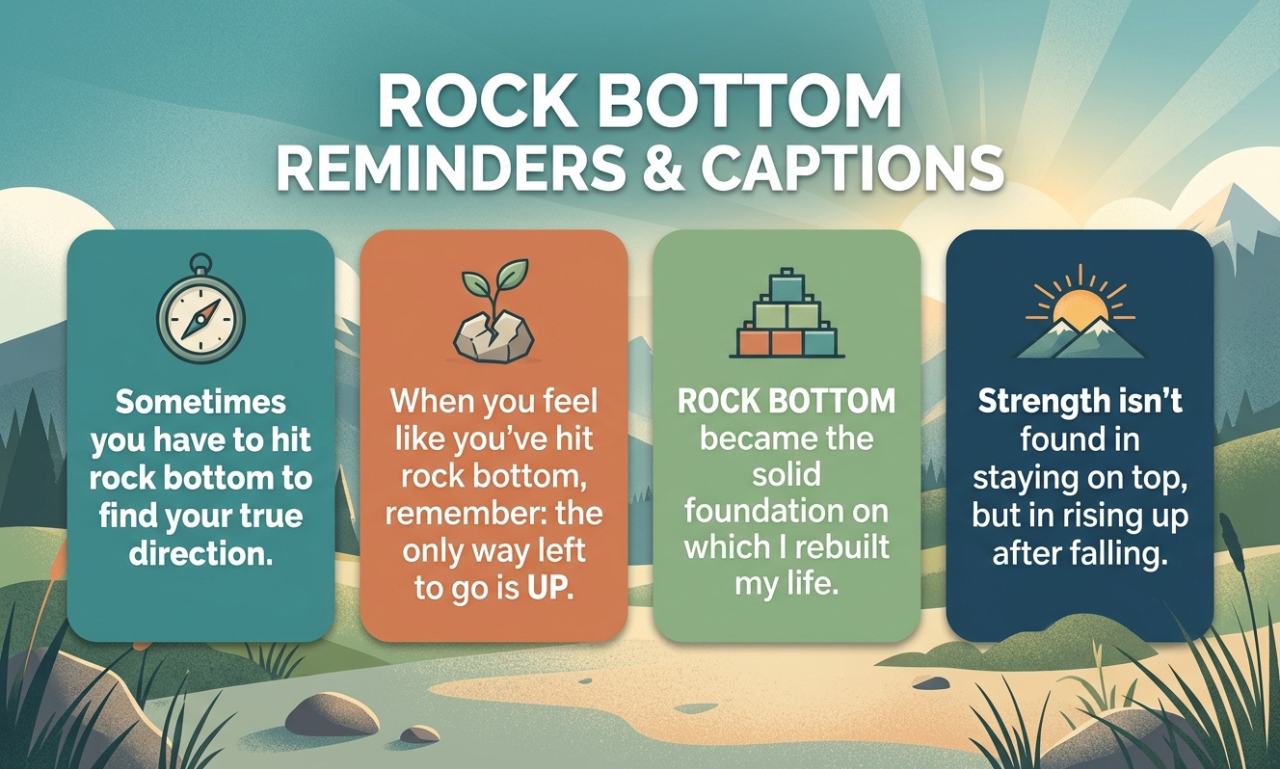
Brief and direct, these short lines work well as quick notes to yourself, journal starters, or simple reminders when your head feels crowded.
- “Rock bottom is a turning point, not an end point.”
- “The floor is solid. Push off.”
- “Scars are just proof that you healed.”
- “What broke you can also teach you.”
- “Stars need darkness to be seen.”
- “Storms clear out old roads.”
- “Rebuild at your own speed.”
- “Take a breath. You are still here.”
- “You can rebuild slowly and still rebuild beautifully.”
- “Your story isn’t over yet.”
- “From the ashes, we start again.”
- “The pain passes; what you learn stays.”
- “Valleys make you appreciate open ground.”
- “Endings are often just messy beginnings.”
- “Pressure shows you what holds together.”
- “Growth hides in small steps.”
- “Steady ground is beneath you.”
- “Pain turns into perspective.”
- “Darkness reveals inner light.”
- “One step at a time.”
- “Courage lives in quiet moments.”
- “Forward is still forward.”
Reflection Prompts & Daily Checklist
For some people, journaling can provide a structured way to put overwhelming thoughts into words and examine them more calmly.
Prompts for Reality Auditing
- The Fact Filter: What are the exact facts of my current situation? Write down what is objectively true without using harsh or dramatic judgment.
- Resource Assessment: What skills, knowledge, or practical tools do I still have access to today?
- Control Identification: What are three small things in my immediate day that I have total control over right now?
Daily Grounding Checklist
- Acknowledge Today: Write down one reality about today without blaming yourself.
- Acknowledge Effort: Record one small task you completed today, no matter how minor it seems.
- Tomorrow’s Focus: Name just one primary focus for tomorrow morning to keep your momentum steady.
5. Stoic & Philosophical Quotes on Overcoming Hard Times
Stoic philosophy reminds us that while we rarely choose the difficult events that happen to us, we retain control over how we respond. These lines focus on perspective and steadying your mind.
- “The impediment to action advances action. What stands in the way becomes the way.” — Marcus Aurelius.
- Context: From Meditations, Book V. Marcus Aurelius explains that external obstacles do not halt progress; rather, navigating around or through the obstacle becomes the new work.
- “You have power over your mind—not outside events. Realize this, and you will find strength.” — Marcus Aurelius.
- Context: Stoicism distinguishes between what is within our control (our choices and actions) and what is beyond our control (external outcomes). Focusing on your choices prevents feelings of helplessness.
- “He who has a why to live can bear almost any how.” — Friedrich Nietzsche
- “Difficulties show what men are.” — Epictetus
Why Rock Bottom Quotes Can Feel So Powerful
When you are going through a hard time, generic advice like “just look on the bright side” can feel completely out of touch. Words centered on hardship resonate for three practical reasons:
- They Acknowledge the Hurt: They validate that things are genuinely tough right now, rather than rushing you to pretend everything is fine.
- They Shift Your Perspective: They help you reframe a bad situation—not by pretending it’s good, but by showing you it can be survived and used as a clean slate.
- They Remind You You’re Not Alone: Reading reflections from people who have experienced difficult periods can remind you that struggle is a normal part of life, not a personal flaw.
Practical Ways to Use These Quotes for Reflection
Quotes aren’t magic fixes, but using them intentionally can help quiet a spiraling mind. Here are a few grounded ways to use them in daily life:
- Journal Starters: Pick one quote in the morning and write a few lines about how it fits into what you’re dealing with right now.
- Simple Desktop Notes: Put a short line on your phone lock screen or a sticky note by your coffee maker to remind you to slow down during stressful moments.
- Reframing Your Thoughts: When a thought like “Everything is ruined” pops into your head, write down a grounded quote next to it to balance your perspective.
- Checking on a Friend: If someone you care about is quietly struggling, send them a simple line to let them know you’re thinking of them—no pressure attached.
Related Quote Collections to Explore
Continue building your perspective with our other curated quote collections:
- Inspirational Quotes for Overcoming Hard Times
- Powerful Mental Toughness Quotes for Resilience
- Encouraging Quotes for Peace and Emotional Healing
- Stoic Quotes on Finding Inner Strength in Adversity
- Short Quotes for Daily Affirmations & Focus
Frequently Asked Questions About Hitting Rock Bottom
What is a well-known quote about hitting rock bottom?
A widely cited quote about hitting rock bottom comes from author J.K. Rowling: “And so rock bottom became the solid foundation on which I rebuilt my life.”
What does hitting rock bottom mean?
“Rock bottom” is an informal expression for a period when someone feels they have reached an especially difficult or low point in their life. For many, it acts as an unexpected turning point where old patterns end and genuine rebuilding begins.
Can hitting rock bottom lead to positive changes?
While it is painful and unwelcome, reaching a challenging point can make it easier to recognize what is no longer working and decide what needs to change going forward.
How can someone stay grounded at their lowest point?
Focus on very small, manageable goals. Rather than trying to solve the coming months or years at once, focus on simple daily needs like resting, eating well, taking a short walk, and reaching out to trusted people.
What does “The floor at the bottom of the pit is solid” mean?
This is an original reflection from this collection. The idea is that reaching a low point can give you stable ground from which to stop falling and begin rebuilding.
What is the difference between rock bottom and burnout?
Burnout is deep, chronic exhaustion caused by prolonged stress or overwork. Rock bottom usually refers to a specific crisis point or realization where circumstances collapse, forcing a reset.
How long does it take to recover after hitting a major setback?
There is no fixed schedule. Recovery depends on your personal situation, the support you have, and taking small, steady steps forward without rushing yourself.
What does “rock bottom has a trap door” mean?
This expression is a gentle warning that without self-care, healthy coping mechanisms, or support, emotional distress can continue to deepen. It encourages seeking help early rather than navigating severe hardship alone.